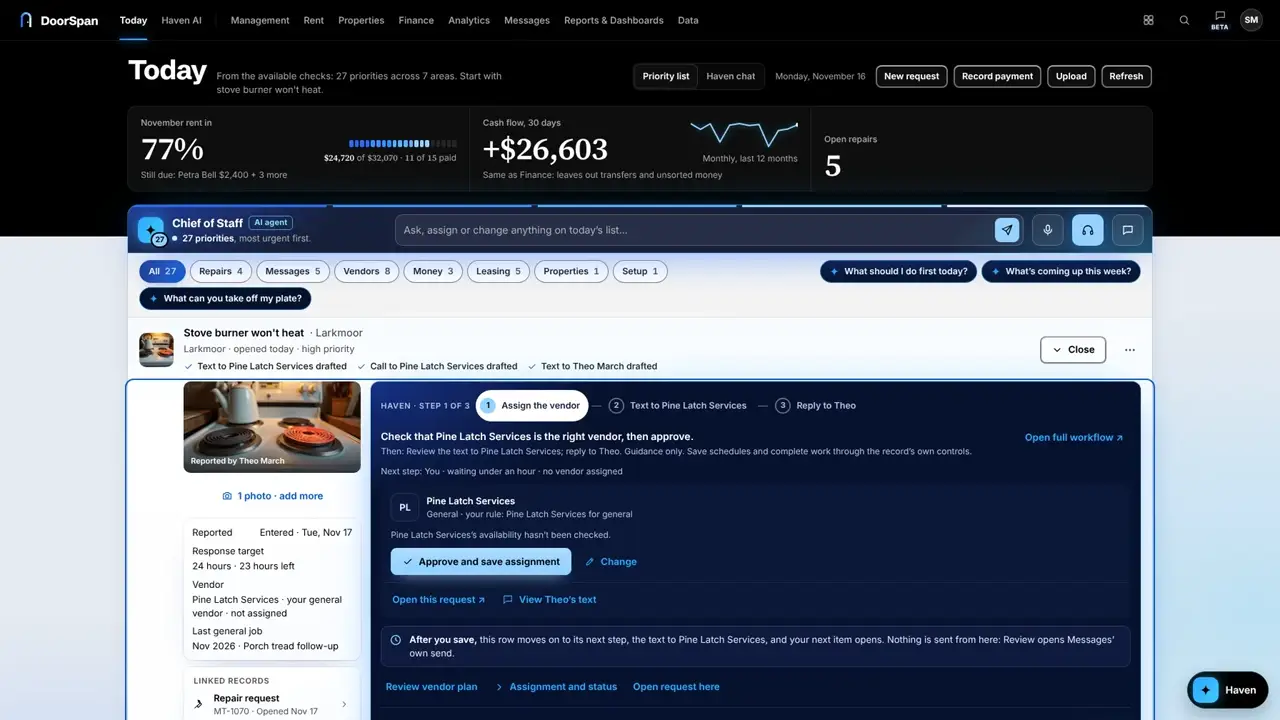
DoorSpan's product videos went live on the DoorSpan website this week. Getting them there forced me to make product, customer, and go-to-market decisions at the same time.
I started with a simple assignment: show people the product. I ended up building a library of website videos and a plan for using them across discovery, evaluation, demos, beta onboarding, and customer follow-up.
DoorSpan is approaching beta. The platform, tenant portal, tenant mobile app, and landlord mobile app are built. I use DoorSpan to run my own sixteen-property rental business while I refine the experience and prepare to put it in front of other operators.
The videos now let prospective customers see how DoorSpan handles real work before deciding whether it fits their business.
My first review changed the assignment
I began by reviewing product films for pace, energy, and clarity. I wanted viewers to see what the assistant contributed and which decision remained with the person.
We also spent a full day creating videos with a set of characters that could have become recurring DoorSpan mascots. I changed direction because I believed a human-centered presentation would connect better with property operators. The final approach uses AI-generated presenters, recognizable customer situations, and the actual product instead of building the campaign around mascots.
The first DoorSpan concept followed a repair from a tenant's report through the property manager's response. During the early review, I found several places where the story broke down.
Some clips felt like screenshots instead of working software. One repair moved through several screens before a viewer could understand what happened. Another scene switched into the tenant portal without explaining why the tenant was there or how the screen related to the work the manager had just completed.
I pushed for actual clicks, visible results, and enough time to recognize the outcome. When the story changed roles or devices, the video needed to explain why and keep the same repair in view.
I applied that standard to the scripts, captions, scene order, and footage we needed to record.
The demonstration had to match the product
I made one production requirement nonnegotiable: show the actual DoorSpan app doing the work. The hero and task loops use the current interface, fictional Apex data, actual user actions, and visible results. We are replacing older coded demonstrations in the narrated films with real recordings as each new cut clears review.
I rejected conceptual animation or editing that suggested functionality the product had not demonstrated. Prospective customers should see the product they would use, including where DoorSpan assists and where the person makes the decision.
The rehearsal process exposed gaps that a polished edit could have hidden.
In one rehearsal, the footage mixed details from two fictional repair examples, and the vendor message did not show the tenant's entry note. DoorSpan supported the full workflow, so we rebuilt the demonstration around one fictional repair. Viewers could then follow the same request from the tenant to the property manager, the vendor, and back to the tenant.
During later reviews, I found a different set of problems. A mobile clip ended on “Making the link…” instead of showing the completed action. Some phone footage did not fit the intended frame. The website and videos used different fictional company names. Several films had captions burned into the video while the website added another caption track, causing the words to appear twice.
Each problem required a specific correction: follow one record through the workflow, retain the customer's operating constraints, show the saved result, record for the intended screen, use one fictional company, and let the website control its captions.
I now apply one test to every scene. The viewer should understand the problem, see what DoorSpan did, know what the person approved, and recognize the result without implying an outcome the footage does not show.
The live videos serve different customer decisions
The public DoorSpan website now uses several types of video.
The site opens with a fifteen-second recording of the real product interface. It shows a repair, the next action, a message to a vendor, and the property manager's approval. Its job is to help a visitor understand the product before reading the rest of the page.
A seventy-five-second introduction shows a property manager's day and the work competing for attention. A three-minute walkthrough connects repairs, rent, messages, renewals, security, and the agent experience.
Focused films answer narrower questions. One shows how a tenant text becomes a repair. Another covers rent collection. Others cover messages and working with DoorSpan's orchestration agent. Silent loops show individual tasks on desktop and mobile while the surrounding page explains the broader value.
Those assets can support LinkedIn, beta email, live demonstrations, and follow-up after a customer conversation. I change the opening, length, and next action for each destination. Cutting the same file to a shorter runtime does not make it useful for every audience.
The videos needed a go-to-market plan
Once the video library took shape, I expanded the assignment. I wanted a plan for the content we need, where to distribute it, how to engage prospective users, where to spend money, and how to build demand through beta and launch.
My initial beta outreach will focus on rental owners and small residential property managers in my network. Operators in Colorado and Chicago have already expressed interest. I will ask counsel to determine where we can open the beta. I hope to include Illinois and all of Colorado, with national participation if the legal review supports it.
I will ask interested operators where their work still sends them across texts, email, spreadsheets, or separate systems. That gives us a concrete place to begin without limiting the beta to one workflow.
The operators who join the beta will receive access to DoorSpan's full functionality. I want to learn which workflows they choose, which use cases emerge through daily work, where the agents help, where users correct them, and which parts of the experience need to improve. I also expect beta users to identify problems and use cases I have not anticipated.
I will use those conversations, usage patterns, and user corrections to improve the product, refine the agents and workflows, strengthen onboarding, and tailor follow-up to each operator.
If someone struggles to track vendor handoffs, I can learn how they manage the work today, show the relevant DoorSpan workflow, and carry their feedback into the product. If rent reconciliation consumes their time, we can work through that process in the app. The videos start the conversation. Beta users will then have the full product to test against the way they run their businesses.
The first LinkedIn video has another job. It should open on a problem an operator recognizes without sound, show enough of DoorSpan to make the response credible, and invite the operator to share how they handle the same work.
My current plan starts with direct conversations instead of paid advertising. I need to learn which problems lead qualified operators to attend a demo, request a start date, return to the product, and pay for it. Views and watch time can help me improve an edit. They cannot tell me whether DoorSpan solved a problem that matters enough for someone to change how they work.
A great product still needs a credible story
During more than fifteen years in big tech, I saw teams invest deeply in products and still struggle to earn adoption when customers could not see how the product fit their work.
I built the story around a real customer problem, a product response viewers could see, and an outcome they could understand. Marketing should make working technology clear without inventing a better version of it.
AI accelerated the production. I directed the customer story.
Claude helped develop the story, plan the shots, coordinate recordings, and revise the cuts. A mix of AI and production tools handled narration, presenter animation, music, editing, captions, and quality checks. The actual DoorSpan interface remained at the center of each workflow demonstration.
I chose the customer story, creative direction, product evidence, and next action. I rejected footage that did not work, challenged missing context, expanded the assignment into a go-to-market plan, and approved the final website assets.
My experience across Customer Success, product, program delivery, solution architecture, UX, and engineering shaped those decisions. Customers compare the story with what the product does when they use it.
When I show people these videos, the reaction I keep hearing is, “This is amazing.” Then they ask how I made them. The toolchain supplied the mechanics. I decided what the customer needed to see, verified that DoorSpan performed it, and refused to let the production claim more than the product could show.
The next test happens with customers
The videos are live on the DoorSpan website. I will use them in direct conversations, focused demonstrations, beta onboarding, customer follow-up, and the next round of outreach.
I will track which videos lead to operator conversations, attended demos, requested starts, repeat product use, and paying customers. I will use those results to choose the stories I develop next.
If you own or manage rental properties and are interested in DoorSpan's beta, send me a message. I would like to hear about the last repair, payment, or tenant handoff that sent you searching through texts, email, and spreadsheets to work out what happened.